
The Difficult Conversations New Managers Avoid and the True Cost of That
Victoria Canham • 9 April 2026 • 8 min read
Every hard conversation you're putting off is accumulating interest. Here's what avoidance costs, and a practical guide to having the conversation this week.
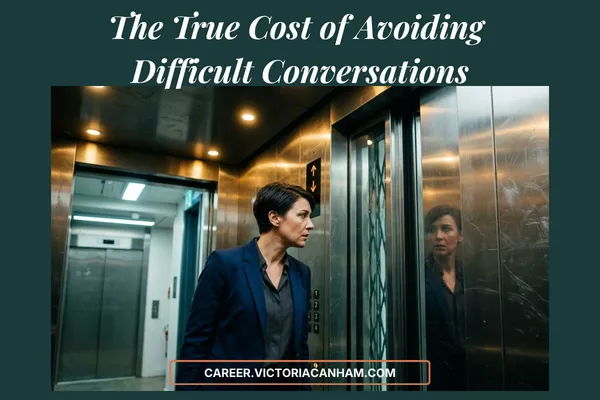
I once spent three months constructing elaborate fantasies about firing someone in a lift.
Not literally, of course. I had no intention of actually doing it. But I had a direct report whose performance was so catastrophically poor that every morning I would step into the office lift and imagine the doors closing, the two of us suspended in that small metal box, and me finally saying the words I had rehearsed in the shower for ninety days.
"Your work is not meeting the standard. We need to talk about what happens next."
In my fantasy, they would nod with quiet dignity. Perhaps they would thank me for my honesty. The lift would ding, we would step out, and the problem would be resolved with the elegant efficiency of a West Wing episode.
In reality, I avoided them for twelve weeks. I sent emails instead of speaking face-to-face. I gave vague feedback that they cheerfully misunderstood. I complained about them to my own manager, who suggested I "address it directly" with the kind of helpfulness that made me want to address him directly with a heavy object.
By the time I finally had the conversation, in a meeting room, not a lift, with an HR representative present because I had made such a hash of the run-up, they were blindsided. I had spent three months performing a pantomime of normality while privately constructing their professional obituary.
They cried. I felt like a monster (honestly, I was). The relationship never recovered, and I learned, at considerable cost to everyone involved, that avoidance is a slow, expensive form of violence.
Why We Avoid: It's Wiring
If you are currently rehearsing a difficult conversation in your head for the fourteenth time while doing nothing about it, you are not morally deficient. You are neurologically predictable.
Your brain processes social threat, the possibility of conflict, rejection, or humiliation, in approximately the same way it processes physical threat. The amygdala fires and cortisol releases, as your body prepares for fight, flight or fawn, which is deeply inconvenient when what you actually need is to have a measured discussion about missed deadlines.
You've probably heard this already, but your brain treats social threat like physical threat. Even fewer people discuss the impact of maintaining that threat state over time.
When you avoid a difficult conversation, you don't resolve the neural alarm; you sustain it. Research on anticipatory anxiety shows that the period before a stressful event often generates more physiological distress than the event itself. Your body remains in a low-grade threat state, pumping stress hormones, disrupting sleep, and impairing executive function. You become, quite literally, stupider about the problem the longer you delay addressing it.
Meanwhile, your brain constructs increasingly catastrophic narratives. The conversation you are avoiding grows in your imagination until it bears no resemblance to reality. You rehearse objections that will never be raised. You anticipate emotional reactions based on your own anxiety, not their personality. You build a cathedral of dread around a conversation that, statistically, will take eleven minutes.
This is your brain doing exactly what evolution designed it to do: keeping you safe from perceived threat. The problem is that evolution did not anticipate office politics.
What Avoidance Actually Costs: The Compound Interest of Silence
Let us be unsentimental about the mathematics.
Research quantifies the business impact of every difficult conversation not held at approximately $7,500 and seven lost workdays. This is not an abstract figure; this is based on the cost of the meetings you reschedule, the projects that stall, the decisions that cannot be made because the relevant people are not speaking honestly to one another.
But the financial cost, while measurable, is not the most expensive line item.
The cultural cost: When you avoid addressing underperformance, you signal that standards are optional. 95% of employees say that unaddressed difficult conversations negatively impact their work. Your best people watch you tolerate mediocrity and begin to wonder why they bother. The culture shifts imperceptibly at first, then suddenly, into one where everyone pretends everything is fine while updating their LinkedIn profiles.
The relational cost: Trust is built through honesty delivered with care. It is destroyed by honesty that is withheld until it explodes. When you finally have the conversation you've been avoiding for months, the other person does not experience it as feedback. They experience it as betrayal. You knew. You said nothing. You let them continue failing while you constructed your lift fantasy.
The identity cost: Every avoided conversation erodes your sense of yourself as someone who leads. You begin to see yourself as someone who manages around problems rather than through them. This is the slow death of managerial confidence, and it is cumulative. 69% of managers report being uncomfortable communicating with employees in general, which is not a skill gap; it is a crisis of professional identity.
Yet, 44% of managers delay difficult conversations for weeks or months. 37% of employees avoid difficult conversations entirely. We are, collectively, paying compound interest on silence while telling ourselves we are being kind.
The Three Conversations New Managers Avoid Most and Why
The accidental manager is not an anomaly. They are the standard.
Every year, the UK produces approximately 400,000 new managers. Of these, only one in five receives appropriate management and leadership training. That leaves over 300,000 accidental managers added to the pool annually, each one stumbling into responsibility with the same misplaced confidence that technical competence equals leadership capability.
The phenomenon is so common that it has a name: the Peter Principle, coined by Laurence Peter and Raymond Hull in 1969. Employees rise to their "level of respective incompetence" — promoted until their performance declines, then left in place because organisations lack either the insight or the courage to move them into roles that actually use their talents.
Modern workplaces have only amplified the problem. Today's managers must navigate remote teams, mental health conversations, generational differences, digital transformation, and AI integration; often without the foundational skills to manage basic one-to-ones effectively.
The result? 60% of new managers underperform in their first two years. 35% of bosses have repeatedly asked their employers for training, with almost half of those feeling "overwhelmed" and "underequipped". Yet still, the promotions continue, the training doesn't materialise, and the cycle repeats.
Your organisation is almost certainly doing this right now. Someone in your company was promoted last month without preparation. Someone is chairing meetings they weren't trained to run. Someone is managing former peers without guidance on how to navigate that transition. Someone is interviewing new team members with no idea how to conduct an effective interview or select the right candidate. Someone is staring at institutional grey carpet, wondering how long until everyone realises they are improvising.
What Organisations Should Actually Do (And Almost Never Do)
1. Addressing Underperformance
This is the conversation I avoided for three months. It is also the one new managers mishandle most spectacularly.
The avoidance pattern: You tell yourself you're gathering more data. You're giving them time to improve. You're being compassionate. What you're actually doing is allowing poor performance to become entrenched, making the eventual correction more severe than it needed to be, and depriving the other person of the chance to improve while improvement is still possible.
The deeper fear: That you are not qualified to judge someone else's work. That you will be challenged and found wanting. That you are, in some fundamental way, an impostor pretending to be a manager.
2. Giving Critical Feedback to Someone Who Didn't Ask for It
Not underperformance necessarily, just something that could be better, such as a presentation that landed flat, a communication style that alienates colleagues, or a habit that undermines their potential.
The avoidance pattern: You tell yourself it's not that important. They're doing fine. You don't want to seem nitpicky. What you're actually doing is withholding information that could accelerate their development because you are uncomfortable with the temporary awkwardness of delivering it.
The deeper fear: That they will not like you afterwards. That you will be seen as critical, difficult, not a team player. That you are, in some fundamental way, unlikeable.
3. Pushing Back on Unrealistic Expectations aka Protecting Your Team
Your manager demands the impossible. A deadline that requires your team to work weekends. A scope expansion with no additional resources. A "quick win" that will derail the actual strategy.
The avoidance pattern: You tell yourself you're being a team player. You're demonstrating commitment. You're not making excuses. What you're actually doing is throwing your team under the bus to protect your own reputation with senior leadership.
The deeper fear: That you will be seen as not up to the job, that you cannot handle pressure, or that you are, in some fundamental way, inadequate.
Notice the pattern. Every avoidance is rooted in the same terror: that having the conversation will reveal you are not good enough to be having it. This is the particular psychology of the accidental manager — promoted without preparation, now expected to perform competence while secretly convinced of your own incompetence.
The CLEAR Framework: Having the Conversation Without It Going Off the Rails
Most frameworks for difficult conversations are either too rigid (follow these seven steps precisely or die) or too vague (just be authentic, man). Here is something bespoke: five principles that create structure without script, dignity without detachment.
C — Context: Establish the Territory
Before you say anything substantive, ground the conversation in shared reality. Not "we need to talk" — that triggers threat immediately. Instead: "I want to discuss the presentation yesterday, specifically how the client responded to the financial section."
This does three things. It signals that you are prepared and specific, not ambushing. It gives the other person a cognitive anchor so they know what terrain you're on. And it demonstrates that you are paying attention to their work, not just their failures.
L — Language: Own Your Observations
Use language that describes what you saw or experienced, not what you inferred about their character. Not "you were unprepared" — that is an attack on identity. Instead: "I noticed the financial projections weren't included in the deck, and the client asked questions we couldn't answer."
The distinction matters - the former invites defensiveness, the latter invites problem-solving. You are not a prosecutor building a case; you are a colleague describing reality.
E — Exploration: Ask Before Telling
The most common error in difficult conversations is delivering a monologue. You have rehearsed this. You have your points. You want to get through it. So you talk at them.
Instead: ask. "What was your read on how that landed?" "What was happening from your perspective?" "What would have helped you prepare more effectively?"
This does two things. First, it surfaces information you don't have; perhaps there was a reason for the omission you didn't know about. Second, it signals respect. You are not lecturing, you are investigating together.
A — Agreement: Co-Create the Next Step
Do not impose solutions. Negotiate them. "What would good look like next time?" "What support do you need from me to make that happen?" "How will we know if this is working?"
The agreement must be specific, measurable, and mutual. Not "do better" — that is meaningless. Instead: "The financial section will be included in all client presentations, and we'll do a dry run 48 hours before the meeting."
R — Relationship: Repair and Reconnect
End by affirming the relationship. No hollow reassurance, which reads as manipulation. Instead, provide a genuine acknowledgement of what remains true despite this specific difficulty. "I brought this up because your development matters to me." "This doesn't change my confidence in your potential." "I'm committed to working through this with you."
Then stop talking. Let them respond. Let there be silence if there needs to be. The conversation is not performative, needing to be perfected, it is a moment of connection in which to be present.
What to Do If It Goes Badly Anyway
Sometimes you do everything right and it still detonates. They cry. They shout. They accuse you of bias, cruelty, professional jealousy. They threaten HR, or resignation, or both.
First: do not match their energy. Your calm is their anchor, even if they are railing against it. Let them finish. Do not defend, explain, or justify in the moment. Simply: "I hear that this is difficult. I want to understand more. Tell me more about what's coming up for you."
Second: separate the emotional reaction from the substantive issue. Their distress does not invalidate your feedback. It reveals its importance. If they didn't care, they wouldn't be upset.
Third: offer a pause. "I can see this is a lot to process. Let's take twenty minutes and come back together." Or: "Let's schedule another conversation tomorrow once you've had time to reflect." Do not allow the emotional intensity to force premature resolution.
Fourth: document. Not to build a case against them, but to protect yourself. Note what was said, what was agreed, what the next steps are. Email a summary. Create a paper trail of your good faith.
And finally, do not let their reaction deter you from future necessary conversations. One difficult outcome does not mean the framework failed. It means the conversation was genuinely difficult, which is why you needed a framework in the first place.
The Conversations I Wish I'd Had Sooner
I have been managing people for twenty-five years. Here are the conversations I still regret not having earlier:
The conversation about my own limitations. Early in my career, I pretended to understand strategies I didn't, processes that confused me, expectations that were unclear. I wasted months performing competence I didn't have, instead of admitting ignorance and learning faster.
The conversation about their ambitions. I managed people for years without asking what they actually wanted from their careers. I assumed, or I projected, or I simply didn't think it mattered. It matters enormously. You cannot develop people if you don't know where they want to go.
The conversation about my manager's expectations. I spent years trying to read minds, interpret silences, decode ambiguous instructions. I could have saved myself extraordinary anxiety by simply asking: "What does success look like here? What are you actually measuring?"
Every one of these would have been uncomfortable. Every one would have accelerated my development and the development of the people I was responsible for. The discomfort was the price of admission. I kept trying to sneak in without paying.
The Product I Wish I'd Had
This is why I built the Accidental Manager Survival Kit — a structured programme for people who have been promoted without preparation and need to navigate the transition without losing their minds or their teams.
It includes:
☆ The Difficult Conversations Module: Preparation protocols, flexible frameworks, and recovery toolkits for the ten most common hard conversations new managers face
☆ The Identity Shift Workbook: Because moving from doing the work to leading the people who do the work is not a job change — it's an identity transformation
☆ The Protection Strategies: How to push back on unrealistic expectations without throwing your team under the bus, and how to protect your own development when the organisation won't
☆ The Practice Sessions: Low-stakes rehearsal with feedback, because the only way to get better at management is to do it, but you don't have to practise on your actual team
It is the resource I wish I'd had in that lift, rehearsing my fantasy while reality deteriorated around me. And it is the resource I wish I'd had in Cape Town, staring at institutional grey carpet while ten strangers waited for me to lead.
If you are currently constructing your own lift fantasy about underperformance, or critical feedback, or pushing back on unrealistic expectations, you do not need to figure this out alone. The framework exists. The support exists. You simply need to decide that the cost of avoidance has finally exceeded the cost of action.
Follow along for weekly support on exactly this stuff — or DM me @coachvictoriacanham if you need support now.
Victoria Canham is an ICF Professional Certified Coach who helps new managers navigate the transition from doing the work to leading the people who do the work. She has had approximately 4,000 difficult conversations since the lift incident, and has finally stopped rehearsing them in elevators.
Recommended Reading
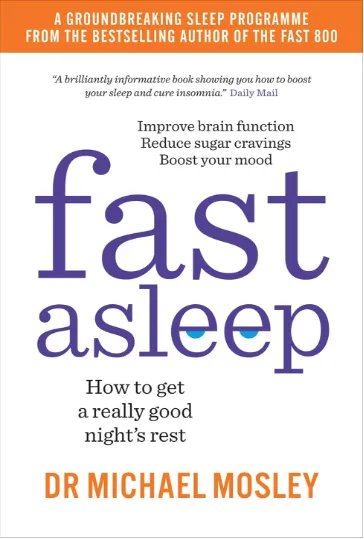
Fast Asleep: How to get a really good night's rest by Dr Michael Mosley
A good night's sleep is essential for a healthy brain and body. So why do so many of us struggle to sleep well? In Fast Asleep, Dr Michael Mosley explains what happens when we sleep, what triggers common sleep problems and why standard advice rarely works.
Prone to insomnia, he has taken part in numerous sleep experiments and tested every remedy going. The result is a radical, four-week programme, based on the latest science, designed to help you re-establish a healthy sleep pattern in record time.
With plenty of surprising recommendations - including tips for teenagers, people working night shifts and those prone to jet lag - plus recipes which will boost your deep sleep by improving your gut microbiome, Fast Asleep provides the tools you need to sleep better, reduce stress and feel happier.
We’re not just about overcoming obstacles, we’re about transforming lives.

Victoria Canham - Career & Leadership Coach
Victoria is an ICF-accredited certified professional coach, who offers personalised performance coaching. With a background in change management and countless hours of professional coaching training and experience, I made the big switch to full-time coaching in 2020. I know what it is like to suddenly have the rug pulled out from under you while you're busy making other plans, as a result, I now help people like you to bounce back from adversity and major setbacks to emerge stronger and better than ever before. Our clients have transformed from feeling overwhelmed by life's challenges to confident, goal-driven individuals who navigate life's obstacles with ease. They've achieved their personal and professional objectives and embodied peak performance in all aspects of life. You too can experience this transformation. This is your moment. Your chance to take control, to choose growth over stagnation, achievement over inaction. This is your opportunity to prove to yourself that you're not defined by your challenges—you're defined by how you rise above them. Are you ready to transform your life and achieve peak performance?
Hang out with us on social media


© Copyright 2026 | Victoria Canham Consultancy